
This is one of a five-part series documenting nation-building projects that will make Canada work better and secure our economic future for generations.
Canada is sitting on top of one of the most valuable untapped energy resources in the world—one that generates energy with almost zero pollution and no ongoing fuel costs—and almost no one is taking it seriously.
Under our feet, the Earth is generating a constant supply of clean heat that has been building for four billion years: geothermal energy. We now have the technology to tap it at scale.
As new geothermal technologies mature, Canada’s expertise with drilling and its vast geographic advantages put us squarely in a position to lead a new global industry, while providing energy to Canadians more cheaply than almost any other source available.
A bold national program to build Canada’s geothermal industry would:
• Add significant, always-on clean power to the grid
• Create thousands of jobs for skilled trades
• Lower electricity costs for consumers and businesses
• Position Canadian companies to compete in a $3.5 trillion CAD global market
• Give remote communities energy independence they’ve never had
Why Geothermal is a Project of National Interest
Canada has developed, to date, less than six megawatts of geothermal power capacity, roughly enough to power a small town, writes the RBC Climate Action Institute. Compare this to Europe. The European Geothermal Energy Council Market Report 2024 points out that Europe has nearly 150 geothermal electricity plants and over 400 geothermal district heating and cooling systems. Plans for another 500 district energy projects are in development.
Why has Canada been slow off the mark? It’s not a scarcity issue. As the Cascade Institute points out, “Existing data from Natural Resources Canada suggests that Canada’s geothermal energy potential exceeds current national energy demand by more than one million times.” Canada has been sitting on a lake and drinking with a teaspoon.
Only 40 percent of Canada’s territory has been mapped for geothermal resources, and while that has shown a wealth of opportunity, we don’t yet really know our true potential, writes the Cascade Institute research team. What we do know is that the western and northwestern regions sit on some of the strongest geothermal gradients in the world.
Canada is not behind on geothermal because the resource is weak. We’re behind because of a lack of imagination about how to power our future.
The Global Market is Moving Fast and Canada is Being Left Behind
In June of 2026, the federal government announced a paltry half million dollars in funding to identify geothermal technology opportunities, as well as R&D to support next-generation geothermal development. Meanwhile the rest of the world is already building out geothermal technology and projects at scale. Global investment in geothermal was over $25 billion CAD in 2025 and the IEA projects this to reach $3.5 trillion CAD by 2050, pending advances in next-generation geothermal.
As countries join the race for domestic clean energy—and seek to leave behind volatile fossil-fuel imports —the expansion of geothermal has attracted huge interest in Europe and beyond. Investment in next-gen geothermal alone has grown by an average of over 90 percent annually since 2018.
China and Indonesia are rapidly expanding deployment, and the Philippines already has dozens of geothermal power plants generating enough electricity for nearly eight million homes. The U.S. Department of Energy has committed hundreds of millions to its Enhanced Geothermal Shot program, targeting cost-reduction technologies that would drop the cost of new geothermal projects to less than half that for nuclear or gas—and even cheaper than gas plants that are already built.
Corporations are seeing the benefit of geothermal to their bottom lines. Google, Meta, and Microsoft are investing heavily in geothermal partnerships for data centers.
Despite being the home of many promising geothermal firms, Canada, meanwhile, has no national geothermal strategy, no coordinated research agenda, and no dedicated financial tools to accelerate early-stage projects, writes RBC Climate Action Institute. Only Alberta, British Columbia, and Nova Scotia have geothermal-specific legislation. Given our expertise in drilling methods, Canada has an opportunity to become a global leader in this technology, using it for domestic development as well as exporting technical expertise and equipment, but we are behind the curve.
Always-On Power at a Fraction of Nuclear’s Time and Cost
Wind, solar, and geothermal are the fastest, cheapest, most deployment-ready ways to add clean electricity to Canada’s grid. Wind and solar get most of the attention, but geothermal belongs in the same category.
Where the last three North American nuclear plants have taken a minimum of nine years to build, a geothermal heating plant in France went from breaking ground to delivering heat to 9,000 homes in just 18 months. Iceland’s 100-megawatt Reykjanes power station went from conception to operation in three years, and that was two decades ago, according to HS Orca, the utility’s website.
What sets geothermal apart from wind and solar is that it does not need batteries to be useful. Wind and solar are intermittent: the sun goes down, the wind dies. Pairing them with battery storage now solves this problem, but it adds complexity and cost to every project. Geothermal produces power around the clock without any storage layer, simplifying the system and reducing cost barriers.
Geothermal power plants operate at capacity factors above 90 percent, producing close to their maximum output almost all the time, compared to under 30 percent for wind and solar, writes the Cascade Institute in a position paper on geothermal energy. That is not an argument for geothermal instead of wind and solar, which are forming the critical foundations of Canada’s energy mix. It is an argument for geothermal alongside them, as a clean source of continuous heat and power, and a winning industrial strategy with a far brighter future than oil and LNG.
Conventional, Utility-Scale Geothermal: Proven, Already Happening in Canada
Conventional geothermal taps heat stored in underground water or brine—either close to the surface near volcanic zones, or deeper in hot sedimentary basins—to generate electricity or supply heat directly. Temperatures range from about 40°-150°C for district heating to 150°-350°C for electricity generation, as illustrated in the 1973 diagram by geothermal pioneer Baldur Lindal, discussed by Hungarian researcher Tamas Miklovicz. It is a mature technology used in Iceland, Kenya, New Zealand, and the western United States for decades. Canada has several projects now in development that use this approach:
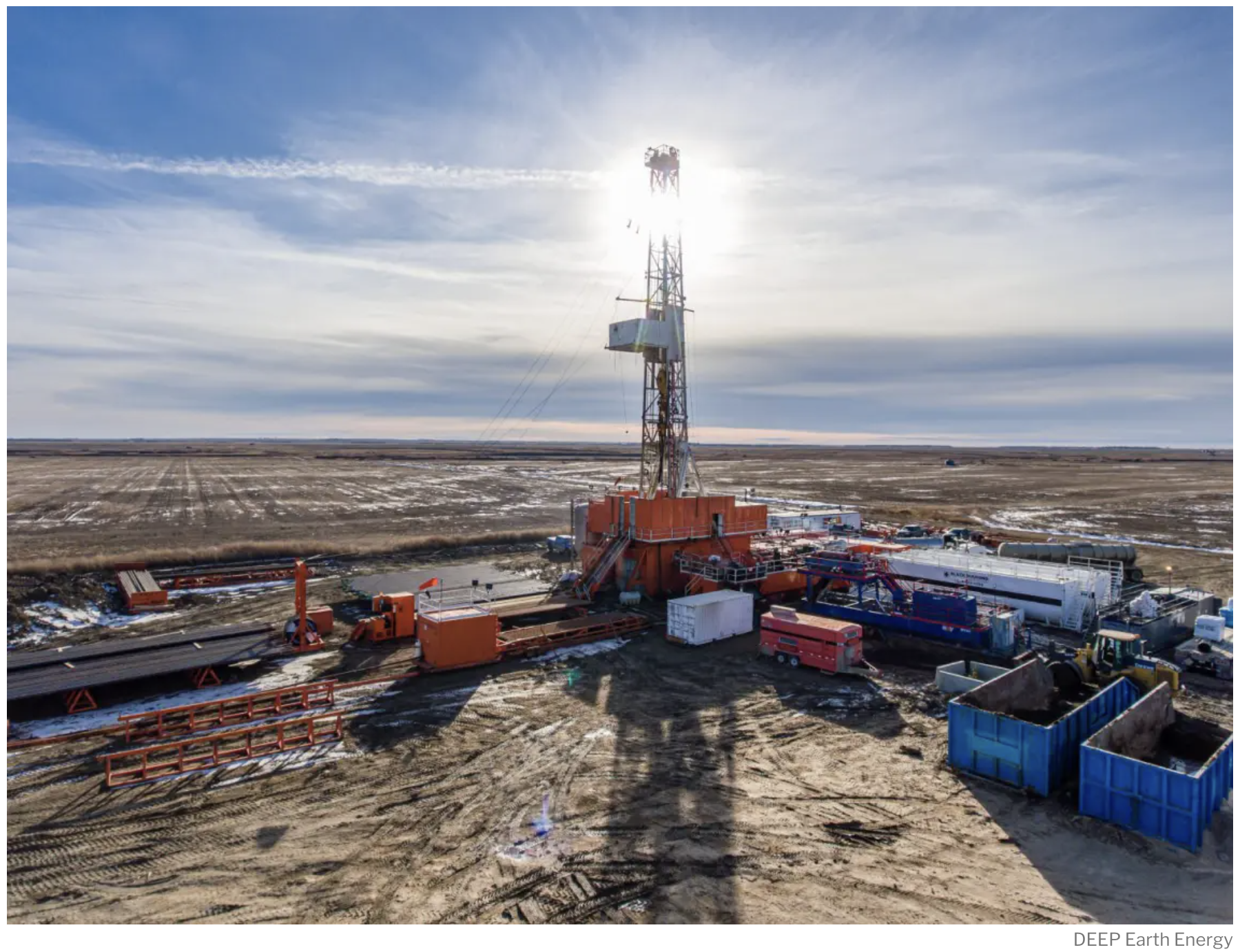
• DEEP Earth Energy Production Corporation in southern Saskatchewan is developing a facility that will tap hot brine from a depth of 3,500 metres in the Williston Basin, writes Climate Insider.
• In Alberta, the No.1 Geothermal project in development by Terrapin Geothermics will produce 10 megawatts of clean baseload electricity and 985 terajoules of heat per year, writes the Alberta Energy Regulator.
• In B.C., Tu Deh-Kah Geothermal, 100% owned by the Fort Nelson First Nation, is developing what would be B.C.’s first commercial geothermal electricity plant, enough to power up to 10,000 homes on a grid currently entirely dependent on fossil fuels.
These projects are proving the concept and need federal support to cross the finish line.
Enhanced Geothermal: A Bigger Opportunity
Enhanced geothermal systems (EGS) are a maturing technology that turns hydraulic fracturing—better known as “fracking”—techniques into a new way of unlocking clean power. Water is injected into deep rock and heated in a continuous loop that delivers energy but doesn’t deplete groundwater or use chemical “frac fluid.” It’s a technological breakthrough that multiplies the available resource by orders of magnitude.
Deeper drilling accesses hotter formations and produces cheaper energy: in geothermal, deeper is cheaper over the long game. The Cascade Institute—whose ultradeep geothermal program is a leading effort to exploring Canadian applications of the technology—contends that with continued innovation, enhanced geothermal could deliver electricity more cheaply than almost any other source available, including nuclear, gas peakers, and in some scenarios even wind and solar.
Streamlined regulations for enhanced geothermal projects are currently under review in the U.S. Congress, following estimates that EGS could power 65 million U.S. homes by 2050, writes Mongabay.
Building-Level Geoexchange Systems: An Everywhere Energy Solution
Large-scale geothermal plants that power grids and district heating networks are only part of the story. The other half is happening building by building, quietly, serving institutional and industrial spaces, mid-rise residential buildings, and even condo towers.
Geoexchange systems use ground-source heat pumps (GSHPs) to transfer energy between a building and the earth. Unlike utility-scale geothermal which taps heat from deep underground formations, geoexchange takes advantage of the relatively stable temperatures found below the earth’s surface. The ground effectively acts as a thermal battery, providing a source of heat in winter and a place to reject heat and cool buildings in summer.
Unlike air-source systems, which lose efficiency and spike electricity demand precisely when the grid is most constrained — during winter cold snaps — geoexchange systems maintain a consistent, modest electricity draw year-round. A U.S. Department of Energy analysis found that widespread geoexchange deployment could cut U.S. winter peak demand by more than 40 GW in 2035, saving roughly $4 billion annually in grid costs.
The technology is mature, feasible in virtually every region of Canada, and applies to a wide variety of building types. Diverso Energy in Ontario has supplied a geoexchange system for a 66-storey condo tower in Mississauga that will be the tallest geoexchange building in North America.
Canada’s Secret Advantage: The Oilpatch
The skills required to develop geothermal energy are almost identical to the skillset required for Canada’s oil and gas workforce. The International Energy Agency estimates that 80 percent of oil and gas skills are directly transferable to geothermal.
Tim Weber, co-founder and CEO of Diverso Energy, builds geothermal systems for buildings across Ontario, and reports that the crews doing the drilling come overwhelmingly from oil and gas. On Diverso’s sites, Weber says, 90 to 95 percent of the workers came out of the oilpatch. The drilling skills carry over directly.
What changes is the life around the job. Oil and gas drilling often means weeks in remote camps. Most geothermal projects, particularly geoexchange projects, occur in cities and residential areas. Diverso’s projects are located next to the buildings that use them, so the work can happen near where people live.
The pay can be steadier too. Weber points out that in oil and gas, a meaningful share of take-home pay comes through bonuses that move with the oil market, so income rises and falls with prices that workers don’t control. Geothermal income is more consistent and reliable.
But the draw of geothermal work is not only the schedule and the pay: it’s the chance to keep doing the drilling work they take pride in, as part of a growing industry rather than one undergoing an ongoing contraction.
The Centre for Civic Governance report Jobs for Today estimates that building out 8,000 MW of geothermal electricity into Canada’s grid would create 51,000 job-years of employment for the construction trades and 3,000 permanent operations jobs—and this is only for electrical generation, not for district energy systems or geoexchange installations, all of which stand to have broader application and significant job opportunities.
Eavor Technologies, based in Calgary, was built on the same instinct that linked the oil and gas industry and geothermal technologies. Founded by oilpatch engineers, Eavor’s innovative “closed-loop” geothermal technology uses the drilling expertise developed in Alberta’s oil and gas sector to build what it describes as the world’s first truly scalable form of clean baseload power.
Careers in Energy quotes Eavor’s estimate that further development of a Canadian geothermal industry could create over 5,000 new jobs for displaced oil and gas drilling contractors and oilfield service workers. That estimate does not account for the export opportunity. Canadian firms are already exporting, says the Cascade Institute: Streamflow and Pro-Pipe are supplying high-temperature tools originally developed for the oilsands to geothermal projects abroad, positioning Canada as a global supplier of geothermal innovation particularly suited to cold-climate and deep-well applications. The expertise that built the oilpatch can build a global industry.
Lower, More Stable Energy Bills
Geothermal power plants have almost no fuel costs once they are built. Following the upfront investment, the energy is just there, every day, for free. That is fundamentally different from a gas plant, which is exposed to fuel price volatility every time energy markets shift. When geothermal is part of the electricity mix, the grid becomes less vulnerable to price spikes, and that stability flows through to the bills that Canadian families pay every month.
In communities where geothermal systems pipe warmth directly into homes and buildings, the way natural gas systems do but without the fuel cost, homeowners and businesses often save 40 to 70 percent on annual utility bills after switching, according to Envirotech Geothermal. For a family spending $3,000 a year on heating, that is $1,200 to $2,100 back in the household budget every year, money that stays in the community instead of going to a fuel supplier.
Reliable Power When It Matters Most
Geothermal runs 24 hours a day, seven days a week, at over 90 percent of its maximum output, writes the Cascade Institute. It does not slow down in a drought like hydro can, and in systems where battery storage has not been deployed at scale, it can provide a needed backstop. For remote and Indigenous communities currently dependent on diesel generation that can be disrupted by weather, road closures, or supply chain problems, geothermal offers something genuinely transformative: energy independence that does not depend on a fuel truck showing up.
A $3.5-Trillion Global Market Canada Is Not Yet a Part Of
The IEA projects global investment in geothermal could reach $3.5 trillion CAD by 2050. Canada has the technology, the engineering talent, and the geological endowment to be a major player in that market, not just as a consumer of geothermal power but as an exporter of geothermal technology and expertise. Geothermal meets all three criteria for inclusion in Canada’s industrial strategy: market potential, resource potential, and innovation potential, making it a natural fit for federal investment alongside critical minerals, hydrogen, and clean electricity.
Power for Remote and Indigenous Communities
Remote and Indigenous communities in Canada’s north pay some of the highest electricity prices in the country, because they run on diesel that must be trucked or flown over vast distances. In some northern communities, electricity costs five to 10 times what urban Canadians pay. Renewables like geothermal change that equation permanently, and the savings stay in the community, instead of flowing out to fuel suppliers and distributors. For communities where energy costs consume a disproportionate share of household income, that shift can be transformative.
The federal and provincial governments have already committed over $50 million to the Tu Deh-Kah project in Fort Nelson as a model for what is possible, writes West Coast Climate Action Network. The Cascade Institute’s research on geothermal exploration and Indigenous data sovereignty provides a framework for scaling that approach to communities across the north in ways that advance Indigenous economic self-determination rather than repeat the extractive patterns of the past.
Alberta as a Clean Energy Exporter
Alberta has the most developed geothermal regulatory framework of any Canadian province and the largest concentration of drilling expertise in the country. A national geothermal program would be, in practical terms, a major economic development program for Alberta, creating stable long-term employment for the oilpatch workforce in a sector that is growing rather than contracting. The Alberta Energy Regulator projects compound annual growth of 26% in geothermal electricity generation through 2034, even without a national program to accelerate it. With one, the growth potential is substantially larger.
How This Connects to the Broader Clean Economy Buildout
An East-West grid would carry clean power across the country. Canada’s home revolution would ensure the buildings on that grid use power smartly. Tripling clean energy production would fill that grid with power when conditions are right, and geothermal could be a cornerstone: constant, reliable, made-in-Canada power generated by Canadian workers using Canadian expertise.
That expertise will provide energy to Canadian homes and communities, and can also be exported to a world that is racing to electrify with clean, reliable, and affordable energy. Canada has built world-class industries before on the strength of what lies beneath its surface. Geothermal should be next. The workers are ready, the companies are already competing globally, and the resource is waiting. The missing piece is a bold national commitment to treat Canada’s deep heat as the asset it has always been.
This story is part of The Energy Mix’s partnership with Small Change Fund.