
Aug 1, 2026, Opinion piece by Kam Mofid and Jatin Nathwani, published by the Calgary Herald
Private capital markets have already rendered a verdict on a new pipeline yet governments rallying on to build one. Nobody has explained why Canada must build a new line before finishing the cheap expansion of the one it already owns.
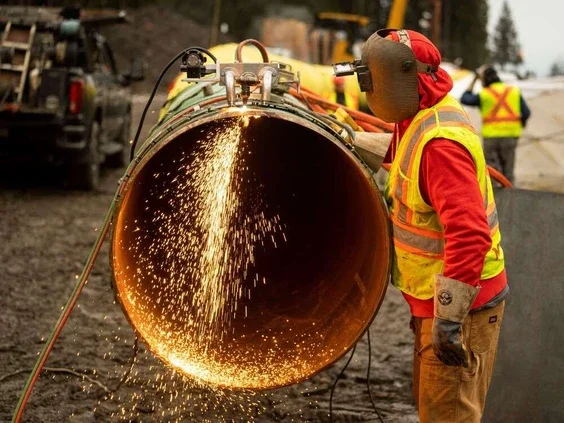
Canadian oil producers struggled for years with too few export pipelines, which forced companies to sell oil at ever larger discounts. Now with a second West Coast pipeline in the works, are we sure global oil demand will still be there in 15 years? PHOTO BY JOHN LEHMANN /AFP via Getty Images
In 1975, a young engineer at Kodak named Steve Sasson built the first digital camera. It was the size of a toaster, ran on 16 batteries, and took 23 seconds to record a single grainy black-and-white image.
He carried it into a meeting with senior management, who listened politely and asked why anyone would ever want to look at photographs on a television set.
Kodak did not miss digital photography. Kodak invented it. The company patented the technology, funded the research for decades and built early digital cameras that worked. What Kodak could not do was move its money.
Film was extraordinarily profitable — high margins, repeat purchases and a global supply chain. Every digital decision got measured against the damage it could do to the film business, and the answer was the same. In January 2012, the company with a market share of 90 per cent filed for bankruptcy protection.
That is not a story about failing to see the future. It is a story about seeing it clearly and putting the next dollar somewhere else.
Canada is about to make a similar decision, and it is fraught with danger. The risk is that pipeline assets are stranded as use of oil globally decreases in homes, buildings, heavy industry and transportation, due to the ever-growing generation of clean electricity accelerating broad-based electrification.
Ottawa and Alberta have proposed a new pipeline from Bruderheim, northeast of Edmonton, to a marine terminal on British Columbia’s south coast, carrying more than a million barrels a day. Alberta’s submission to the federal Major Projects Office puts the cost between $35.2 billion and $43.7 billion.
It was announced as a public-private partnership. Ninety per cent of it is government held.
Calgary’s Pembina Pipeline would hold 10 per cent through construction, with a chance to double that once oil is flowing. The rest sits with two Crown corporations — federally owned Trans Mountain and the Alberta Petroleum Marketing Commission. Which is to say, with you.
That ownership structure is the most important fact in the file, and it has nothing to do with the environment. If a million-barrel-a-day export line to Asia promised strong returns over the next 40 years, pipeline companies, infrastructure funds and pension plans would be elbowing each other for a stake.
They aren’t. Private capital does not need to hold a news conference to render a verdict.
For scale: the Trans Mountain expansion, on much the same corridor, was pitched at $5.4 billion and the actual cost came in at $34 billion. Add the carbon-capture project it is politically bundled with — and the $10 billion Ottawa has committed to the Roberts Bank port corridor — the taxpayer exposure runs toward $70 billion.
Now, the honest case for building it is stronger than opponents usually admit. Canada sells its oil to one customer, and that customer has shown it will use tariffs as leverage. Trans Mountain was meant to fix that, and it largely did. The line now runs near capacity with exports to Asia, and the discount on Canadian heavy crude narrowed from roughly US$19 a barrel to about US$12.
But the argument for a second pipeline is weak. The cost of expansion of existing capacity on the TMX line is a small fraction of a $40-billion commitment for a second pipeline. And before committing 40 years of capital, are we sure global oil demand will still be there in 15 years?
Canada does not have an interconnected electricity grid. When drought hit western reservoirs, Canadian electricity exports fell in 2023, while imports climbed — the third-largest hydroelectric producer on earth, buying power from the United States.
A dry year in British Columbia cannot be covered by wind on the Prairies, because the wires do not exist.
Fixing the grid is the foundational economic infrastructure of the next 20 years, and it is where the jobs are. Data centres, critical-mineral refining and low-carbon steel locate where power is abundant, reliable and competitively priced. Cheap clean power is also what persuades a battery-maker to refine Canadian lithium, nickel and graphite here rather than shipping the ore to Asia — localize the technology in Canada, licence it and manufacture and train the workforce here.
Each of those decisions carries a long tail — tool-and-die shops, power electronics, control systems, grid software, maintenance contracts. Those are high-paying manufacturing and service jobs hard to move offshore. The deepest emissions cuts would arrive as a byproduct of electrification rather than as its price, given Canada already generates roughly four-fifths of its electricity without emissions.
Nor is this a plan to take something from Alberta. Alberta has some of the best wind, solar and geothermal resources in the country, and the only fully deregulated power market in Canada to monetize them.
In a properly connected national system, Alberta is a seller.
So, a modest proposal. Put an interprovincial transmission backbone through the same Major Projects Office, on an accelerated timetable, with the same Crown balance sheet standing behind it. Let the two projects compete for the same public dollar on the same terms.
If Ottawa can move a $40-billion pipeline in 18 months, it can move wires.
Kodak’s board never voted to lose. It voted, again and again, to protect the business it understood, using numbers that were accurate every single quarter until they weren’t.
The danger for Canada is not that oil suddenly becomes worthless. It is that we mistake a customer who still wants film for a future that always will.
Kam Mofid is the founding managing director of BSIA Centre for Clean Energy and Electrification.
Jatin Nathwani is the research director of BSIA, as well as professor emeritus in Management Science and Engineering at the University of Waterloo.