
March 4, 2026 by Carlo Cariaga at ThinkGeoEnergy
FutEra Power will be deploying their proprietary PowerFlow technology at a closed-loop geothermal pilot project in Swan Hills in Alberta, Canada.
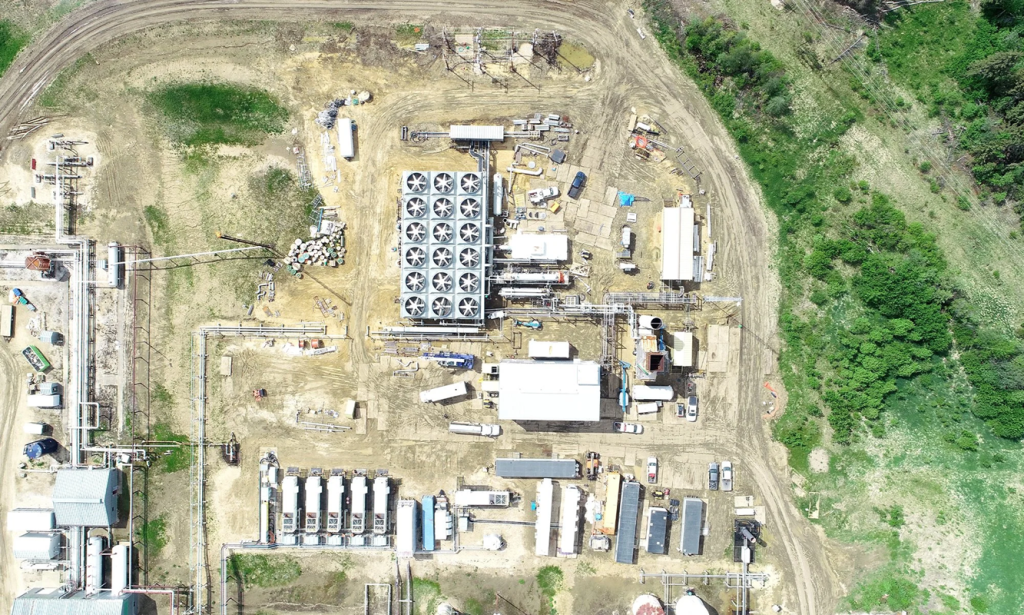
The co-produced geothermal hybrid power project in Swan Hills, Alberta, Canada (source: FutEra Power)
FutEra Power Corp (FutEra) has announced that it has been awarded a grant of up to $5 million which will go towards a closed-loop geothermal pilot project in Swan Hills in Alberta, Canada. This pilot project will serve to test a proprietary Advanced Geothermal System (AGS) called PowerFlow. As part of the project, FutEra will complete the first large bore drilled geothermal well in Alberta.
The project will commence the front-end engineering design (FEED) phase in the first quarter of 2026. Based on the preliminary schedule, the start of operations of the facility is targeted by late 2026 or early 2027.
The grant was awarded by Emissions Reduction Alberta (ERA) under the “Partnerships Intake Program.” This follows up on a previous collaboration with both ERA and Alberta Innovates to build the first geothermal co-production power facility at Swan Hills, which went into commercial operations in September 2022. The project combines an Organic Rankine Cycle turbine producing electricity from geothermal energy and a natural gas turbine, with a total installed capacity of 21 MW.
As Lisa Mueller, President & CEO of Futera, states, the company brings decades of oil and gas innovation to produce geothermal energy at the wellhead using the PowerFlow approach. Mueller added that the growth plan of FutEra is to work with conventional energy producers to develop clean power and heat facilities leveraging existing oil and gas infrastructure.
Justin Riemer, CEO of ERA, further commented that the FutEra project utilized Alberta’s expertise to convert end-of-life oil and gas assets to produce zero-emission electricity and heat. “By repurposing existing infrastructure, it cuts methane emissions, avoids new environmental impacts, and demonstrates how current assets can deliver clean, scalable energy and skilled jobs for Albertans.”