
Feb. 3, 2026, by Marco Chown Oved, published by The Toronto Star
At a time when employment in the oilpatch is declining, building housing with renewable energy is a natural pivot for the Canadian economy and those who earn their livelihood from drilling.
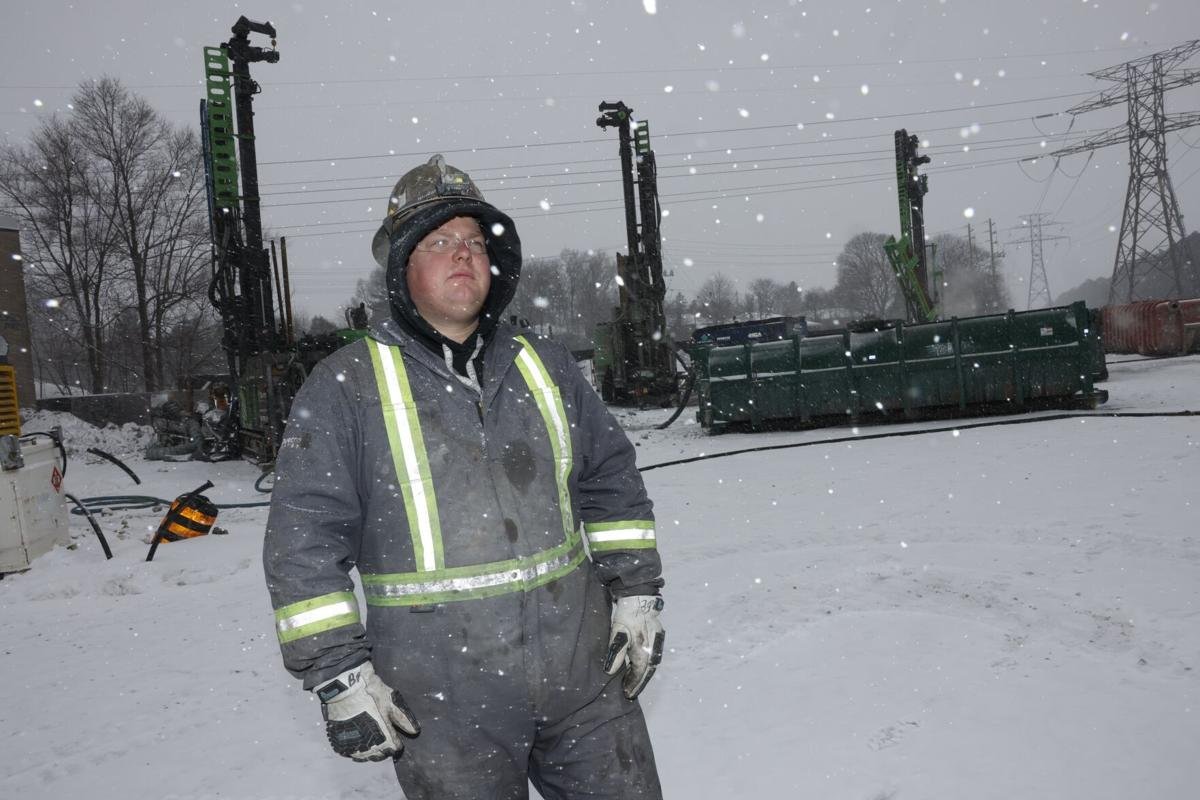
Benji Perry, experienced as an oil field worker in Alberta, at Kennedy Green housing development in Scarborough. Perry lives in Newfoundland but commutes to the GTA to work on geothermal drilling.
Lance McMillanToronto Star
Standing beside a drilling rig in his mud-splattered coveralls and hard hat, Newfoundlander Benji Perry is the archetype of a Canadian oil worker.
He lives outside of St. John’s and flies in and out of the work site every three weeks to make a living.
But after 15 years of living in workcamps, Perry made a switch and is no longer drilling for oil in Alberta. For the last five years, he’s been drilling for geothermal heating in the GTA instead.
“The old days, I’m not gonna lie, they were rough. A lot of yelling. It’s hardcore rigging, right? It was just as much of a lifestyle as it was a job,” he said. Living in a remote camp with 300 men, working 12 hour shifts was “the closest thing you’re gonna get to jail.”
“This is totally different. Same concept drilling-wise, but as for a lifestyle, it’s mellow. You’re actually got a life,” Perry said. “I can go to a movie or to a mall. I can even go out for wings and a beer.”
At a time when employment in the oilpatch is declining, building housing with renewable energy is a natural pivot for the Canadian economy. Drillers like Perry, who once added emissions to the atmosphere, are now hard at work reducing them.
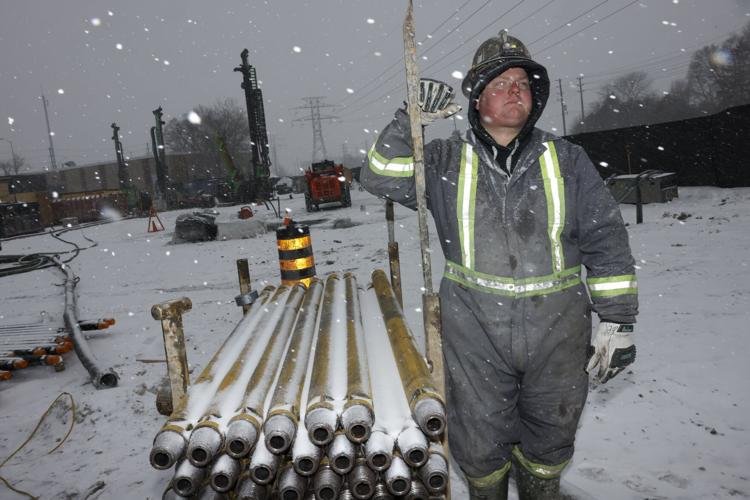
For the last five years, Benji Perry has been drilling for geothermal heating in the GTA.
Lance McMillan/Toronto Star
“I can go back to oil and gas tomorrow. But then when April rolls around, I could be done work for who knows how long,” he said. “But here, geothermal is more steady work.”
In this way, drilling for geothermal is renewable, not just for the environment, but for the workers too.
“Renewable? A guy can renew his mortgage, I guess, because he’s got steady work.”
Oil industry jobs dwindling
The oil and gas sector in Alberta isn’t the job generator it once was. Since 2014, oil production has increased by more than 40 per cent, but employment has dropped by almost 20 per cent. According to Statistics Canada, 10,000 people lost their jobs in the oilpatch last year alone.
More efficient processes, automation and driverless trucks makes oil work safer, but employs fewer people, undercutting claims by the fossil fuel industry that it’s a key driver of Canada’s economy, says economist Jim Stanford, director of the Centre for Future Work.
“We have seen a significant and steady decline in fossil fuel employment, and the great irony is that has happened even as the amount of oil and gas production has been expanding. So the industry is producing more but hiring fewer people to do it,” said Stanford, who co-authored a recent report on the transition away from fossil fuel jobs.
The entire oil and gas industry now accounts for less than 1 per cent of total employment in Canada, the report found.
Benji Perry, experienced as an oil field worker in Alberta, at Kennedy Green housing development in Scarborough. Perry lives in Newfoundland but commutes to the GTA to work on geothermal drilling.
Lance McMillan Toronto Star
“Regardless of the twists and turns of climate policy debates, that decline will continue, driven by deeper economic and technological factors. The choice for Canadians is not whether a shift away from fossil fuel work will occur, but how we will manage it,” it stated.
Meanwhile, work in the green economy, installing solar panels and heat pumps, assembling EVs and mining for batteries, is on the rise.
If Canada achieves its goal of net-zero emissions by 2050, it would mean 1.5 million fewer jobs in oil and gas but 2.2 million more jobs in renewable energy, according to a report put out by Clean Energy Canada in 2023.
This “black to green” transition carries even more of an upside worldwide, with 12 million new jobs in clean technology and climate mitigation far outnumbering 2.5 million job losses in the oil industry, according to a report prepared by McKinsey for the World Economic Forum last year.
“There is no doubt that the energy transition will be a net job creator,” Stanford said.
Drilling as a way of life
Perry is someone who has always loved hard, physical work and when he was a teenager, he watched uncles and cousins come back from the oilpatch so flush with cash, they’d buy a new truck outright.
So as soon as he finished high school, Perry flew out to Alberta to join a drilling crew in Grand Prairie. It was tough, dangerous work, where roughnecks had to swing giant clamps hanging off chains to add sections of pipe that hold open the hole as the drill descends ever deeper into the ground.
“I was pretty fast moving at the beginning, but once you catch on and learn everything, it’s like basically driving a car. It slows down, you figure out the rules of the road, you know where to be, where not to be. Where to put your hands, not to put your hands,” he said.
“It’s basically like a roller coaster. Big thrill seek. Like every day is something different. It’s a big rush,” said Perry. “Everyone’s basically balls to the wall. It’s a ‘get ‘er done’ kind of atmosphere.”
Looming over the work is the ever-present threat of a blowout, which happens when the drill hits a pressurized oil deposit, sending a torrent of toxic liquid and gas back up to where the drillers are working.
“A blowout is when you lose control of the well and you got oil and gas coming back toward the surface. I experienced one in Zama City in 2010. I had oil shoot out of the ground and 250 feet in the air,” he said. “It’s a good thing we were all masked-up.”
And then there was the money. Back then, a roughneck finishing a shift could take home a cheque for $15,000 for three weeks work.
“I was one of them typical guys. I worked my 20 days, then I was partying for a few days. Then I slept for a couple days, and then I went back to work and done it all over again – a vicious cycle,” he said. “You got too much money. You don’t know what to do with it.”
After the birth of his child, Perry decided to get off the big rigs and move into drilling for core samples in the oilsands, to help find the richest deposits to mine. It was less dangerous, but the work conditions were worse, he said.
He’d work the night shift, drilling for 12 hours in the dark in -40 or even -50 degree weather.
“I went a full 21 days one time. I’ve never seen the sun. Because time I wake up, the sun be down. And the time I go to bed, the sun be still down,” he said.
Sure, the money was good, he said. But living in a remote camp in Northern Alberta made the journey home almost two days long – a drive to camp, a charter to Fort McMurray, then flights to Calgary, Toronto and St. John’s – leaving him barely 3 days in his own bed before he had to get back on a plane and do it again.
So when the opportunity arose to shorten his commute – it’s only a three hour flight to Pearson – Perry jumped on it.
“The last five years here in the GTA is a little better because now I leave at 8 a.m. Sunday morning and I’m home by noon so I can watch football.”
Geothermal is ‘a way better life’
The transition from drilling for oil to drilling for geothermal happened slowly, then all at once. Perry did a few projects — schools in the Maritimes, a subdivision in Edmonton — but the floodgates opened when Mattamy, one of North America’s biggest homebuilders, decided to go all-in on geothermal, with dozens of projects ranging from townhouses to high rises.
Diverso Energy, which specializes in geothermal, has partnered with Mattamy and now has multiple full-time crews drilling at any one time. Poaching from the oilpatch hasn’t been enough and the company now funds two scholarships to put students through the drilling program at Fleming College.
“Geothermal is more steady work. It’s a lot safer and I got more of a life, because if I want to go out for a beer and wings tonight and watch the hockey game, I can. In camp, you can go to the TV room, but there’s probably two or three hundred other guys there watching Dr. Phil, and you can’t watch the game,” said Perry.
“Here you got a way better life. I’m not eating the same old camp food every day … I can just run to No Frills and get a nice steak for dinner,” he said.
During a recent blizzard, Perry walked between the drilling rigs at a condo construction site in Scarborough.
Drilling for oil and drilling for heat aren’t really that different, he says. The geothermal boreholes are much shallower — only about 860 feet, compared to some of the oil wells that went down 2 or 3 kilometres or more — and the drilling rigs are much smaller as a result.
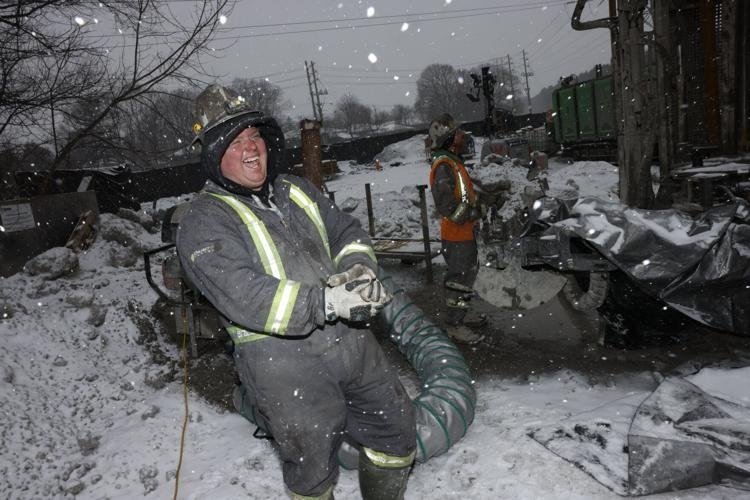
Benji Perry, experienced as an oil field worker in Alberta, at Kennedy Green housing development in Scarborough. Perry lives in Newfoundland but commutes to the GTA to work on geothermal drilling.
Lance McMillan Toronto Star
Geothermal is much safer too, he said. Instead of swinging those giant clamps — called tongs — around with your hands, like they did in the old days, roughnecks simply wait for automated tongs to unscrew the pipe before they grab a section and carry it away.
Afterward, drillers drop U-shaped plastic tubing down each borehole, which will carry a mixture of water and antifreeze in a loop between the surface and the earth down below. Because the temperature is relatively constant at the bottom of the holes, the fluid collects heat in the winter and brings it to the surface, while in the summer it cools down in the holes and brings that cold back up.
This loop is the basis for a zero-emissions HVAC system that uses heat pumps to provide both heating and cooling year-round. (The only associated emissions are from electricity generation, which are minimal in Ontario.)
“There’s a lot of people coming into Canada. They need places to live. Housing is terrible right now. And it seems like geothermal is the way to go for all these new buildings,” he said.
Toronto City Hall says there are nearly 100 approved housing projects with geothermal in the development pipeline that haven’t been built yet.
“A lot of guys out west don’t know about this. They’re out there still stuck in their mindset, and probably every second day they’re looking at the price of oil … And then they’re like, OK, well maybe we’re on our last hole to drill today, are we working tomorrow?” said Perry.
Marco Chown Oved is a Toronto-based climate change reporter for the Star.