
Nov 12, 2025
Steven Sukkau, Winnipeg Sun
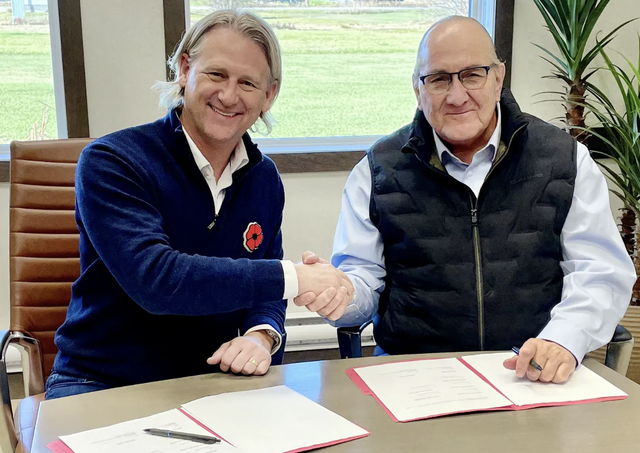
Manitoba Hydro and Fisher River Cree Nation have signed a five-year collaboration agreement to explore renewable energy projects, reduce consumption, and drive economic development in the community. Pictured, Manitoba Hydro President and CEO Allan Danroth (left) and Fisher River Cree Nation Chief David Crate celebrate signing of agreement. Photo courtesy Manitoba Hydro
Manitoba Hydro and Fisher River Cree Nation (FRCN) have signed a new five-year Collaboration Agreement that could pave the way for cleaner energy, reduced consumption, and expanded economic development in the community.
The agreement called mâmawi-atoskêtân, or Working Together, commits the Crown corporation and the Cree Nation to jointly explore and evaluate future energy initiatives. The two parties will identify opportunities, conduct feasibility studies, and, where viable, move ahead with projects aimed at boosting self-sufficiency and supporting long-term growth.
Manitoba Hydro President and CEO Allan Danroth said the initiative is part of the utility’s broader effort to strengthen relationships with Indigenous communities and advance economic reconciliation.
“Manitoba Hydro is committed to strengthening and improving our relationships with Indigenous communities,” Danroth said in a release. “Through the mâmawi-atoskêtân agreement we are charting a new path toward understanding the evolving energy needs of Fisher River and providing the service to support those needs as part of our commitment to economic reconciliation.”
Fisher River Cree Nation Chief David Crate said the agreement supports long-term goals for energy independence and local economic development.
“Our community is looking to the future and the mâmawi-atoskêtân agreement lays the groundwork for greater energy self-sufficiency and economic growth,” Crate said. “We’re looking forward to collaborating with Manitoba Hydro to build a brighter future for our people.”
The agreement creates a formal process for both sides to meet regularly, assess community energy priorities, and launch feasibility studies. A number of potential projects have already been identified, including:
District or individual ground-source heating systems
Expansion of the First Nation’s existing solar farm, currently the largest in Manitoba
A natural-gas connection to Fisher River to diversify energy sources
Energy efficiency assessments of older commercial buildings
Analysis of Manitoba Hydro infrastructure serving Fisher River to determine whether upgrades are needed
Both parties will also explore the potential to pilot emerging renewable technologies, such as community-scale wind development.
The agreement will remain in effect for five years. Manitoba Hydro and Fisher River Cree Nation will each cover their own participation costs. If a proposed initiative proves economically feasible and mutually beneficial, the community and Manitoba Hydro could move into formal project development.
The partners say discussions could begin immediately on identifying priority projects, with feasibility work expected to follow.